Hoboken Neighborhoods Guide: Where to Live & What to Expect in 2026
This Hoboken neighborhoods guide breaks down all seven distinct micro-districts inside New Jersey's Mile Square City so you can match your budget, commute, and lifestyle to the right blocks. From flood-elevation differences and 2026 rent ranges to free public Pre-K and the newest grocery openings, here is what actually matters before you sign a lease or make an offer.
Explore Hoboken Neighborhoods on Google Maps
- Fastest NYC rail commute: Downtown (Observer Hwy to 4th St) puts you within a 3 to 10 minute walk of the Hoboken Terminal PATH, NJ Transit trains, and ferries, though late-night weekend street noise is highest along Newark and 1st Streets.
- Best for families and quiet streets: Uptown (11th to 16th St), Maxwell Place, and the Midtown brownstone blocks (Bloomfield and Garden Sts) combine stroller-friendly sidewalks, waterfront parks, Trader Joe's, and fast 126 bus or 14th St ferry service.
- Biggest value and newest amenities: Northwest and Southwest Hoboken deliver newer elevator buildings, larger two-bedroom layouts, in-building garages, and major resiliency parks—but require checking FEMA Zone AE status and elevation before choosing ground-floor units.
- Highest dry-ground security: Castle Point around Stevens Institute of Technology sits atop the Palisades bedrock ridge, making it the least flood-prone pocket in Hoboken alongside elevated eastern brownstone blocks.
All 7 Hoboken Neighborhoods Compared at a Glance (2026)
| Neighborhood | Boundaries / Streets | Housing Types & Vibe | Commute & Grocery Access | Best For & Watch-Outs / Flooding |
|---|---|---|---|---|
| Downtown Hoboken | Observer Hwy to 4th St (Hudson to Willow) | Classic brick walk-ups, brownstones, select mid-rises; high-energy dining & nightlife hub | 3–10 min walk to PATH, NJ Transit rail & South Ferry; Whole Foods Daily Shop (101 Washington) & Organic Basic Food (204 Washington) | Best for young professionals & FiDi/Village commuters. Watch-out: loudest weekend nightlife near Newark/1st St and tightest street parking. |
| The Waterfront (Shipyard & Maxwell) | Sinatra Dr / River St, 1st to 14th St (peak 10th–14th) | Full-service luxury doorman towers, rooftop pools, Manhattan skyline views; polished & upscale | NY Waterway 14th St & Hoboken Terminal ferries, 126 bus; Kings Food Markets (1212 Shipyard Ln) | Best for luxury amenities, skyline views & ferry commuters. Watch-out: highest rents/HOA fees; active Rebuild by Design coastal floodwall construction. |
| Midtown / Washington St | 4th to 10th St (Hudson to Clinton) | Tree-lined brownstones on Bloomfield & Garden Sts, Church Square Park; balanced classic Hoboken feel | 12–18 min walk to PATH or 2 min to 126 bus on Washington/Willow; ACME (614 Clinton) & Washington St delis | Best for all-around balance, remote workers & young families. Watch-out: walk-ups lack elevators/garages; Washington St bus noise on avenue-facing units. |
| Uptown & Hudson Tea | 11th to 16th St (Hudson to Clinton) | Factory loft conversions (1500 Washington/Hudson), wide sidewalks, quiet family-oriented vibe | Fastest 126 bus via 14th St viaduct + 14th St Ferry; Trader Joe's (1350 Willow), Urban Market (1425 Washington), Weehawken Whole Foods | Best for families & Midtown Manhattan commuters. Watch-out: 22–28 min walk to PATH (rely on shuttle, Citi Bike, bus, or ferry). |
| Castle Point / Stevens Hill | 5th to 10th St east of Washington (Stevens campus & Elysian Park) | Stately historic townhouses, leafy brownstones, campus overlooks; serene & prestigious | 12–18 min walk to PATH, 126 bus on Washington St; easy walk to Midtown ACME or Uptown Kings | Best for quiet historic charm & top flood security. Watch-out: steep hillside walks, scarce inventory, premium purchase prices, daytime college foot traffic. |
| West & Northwest Hoboken | 7th to 16th St west of Clinton (Madison, Monroe, Jackson) | Modern elevator rentals & condos, larger floor plans, attached garages; anchored by 5-acre ResilienCity Park | 9th St Light Rail & Willow Ave 126 bus; ShopRite (900 Madison St) & Monroe Center (720 Monroe St) | Best for square footage, families & car owners. Watch-out: low-lying FEMA Zone AE pockets—protected by H5 pump & ResilienCity Park, but avoid garden-level units. |
| Southwest Hoboken | Observer Hwy to 5th St west of Willow (Madison to Harrison) | Newer mid-rise condos/apartments, Southwest Resiliency Park expansion; quieter residential-industrial mix | 2nd St Light Rail, 12–16 min walk to PATH, fastest car exit to I-78/Turnpike; ShopRite & Downtown groceries nearby | Best for value buyers, reverse NJ commuters & drivers. Watch-out: historic bowl topography (Zone AE) mitigated by H1 pump & resiliency parks—verify building flood elevation. |
How Hoboken's Mile-Square Grid Actually Works
On a regional map, Hoboken looks tiny: roughly 1.25 square miles of land wedged between the Hudson River and the steep Palisades cliffs of Jersey City Heights and Union City. Newcomers often assume that every block inside the Mile Square City feels interchangeable. Spend one week walking from Sinatra Drive west to Jackson Street, or from Observer Highway north to 15th Street, and you quickly discover why seasoned locals talk about Hoboken as seven distinct micro-neighborhoods rather than one uniform suburb.
Understanding the street grid is the fastest way to decode Hoboken real estate, transit access, and storm drainage. Numbered streets run east to west, climbing sequentially from 1st Street near the southern border (just north of Newark Street and Observer Highway) up to 16th Street at Weehawken Cove. Named avenues run north to south in a predictable east-to-west progression:
- Eastern Waterfront & Historic Core: Sinatra Drive / River Street, Hudson Street, Washington Street (the main commercial spine), Bloomfield Street, and Garden Street.
- Central Transition Corridors: Park Avenue, Willow Avenue (a key NJ Transit 126 bus corridor), and Clinton Street.
- Western Bowl & Newer Residential Belt: Grand Street, Adams Street, Jefferson Street, Madison Street, Monroe Street, Jackson Street, and the western edge along Harrison and Marshall Streets.
Moving just four avenues west from Hudson Street to Madison Street changes almost everything about daily life: housing shifts from 19th-century brick walk-ups to modern mid-rise concrete buildings with garages, average price per square foot drops noticeably, and ground elevation dips toward the historic western basin. Meanwhile, moving ten blocks north from 2nd Street to 12th Street swaps late-night PATH convenience for quieter residential sidewalks, larger parks, and express Midtown bus or ferry rides.
The 7 Distinct Hoboken Neighborhoods Explained
1. Downtown Hoboken (Observer Highway to 4th Street)
Downtown is Hoboken's highest-energy corridor and the default landing zone for first-time residents who commute daily to Lower Manhattan or Greenwich Village via the PATH train. Centered around Hoboken Terminal, Newark Street, 1st Street, and lower Washington Street, this area packs the densest concentration of bars, casual eateries, fitness studios, and transit connections in Hudson County.
Housing in Downtown skews toward classic four- and five-story brick walk-ups, converted brownstones along Bloomfield and Garden Streets, and select mid-rise apartment buildings near Observer Highway and River Street. Daily errands got a major upgrade in December 2025 when the Whole Foods Market Daily Shop opened inside a restored historic bank building at 101 Washington Street, supplementing longtime neighborhood staple Organic Basic Food at 204 Washington Street. For green space, Pier A Park and Pier C Park sit steps east of Sinatra Drive with sweeping Lower Manhattan skyline lawns and riverfront playgrounds.
The trade-off is simple: Downtown is lively late into Friday and Saturday nights, especially near Newark Street, 1st Street, and lower Washington. Street parking is tightest here because commuters and nightlife visitors compete with residents. If you want maximum foot traffic and a five-minute walk to the train, Downtown wins easily; if you prefer silence at 11:00 PM on a Saturday, look north of 6th Street or tuck onto a quiet side street like 3rd and Garden.
2. The Waterfront: Shipyard, Maxwell Place & Sinatra Drive
Running along the Hudson River from Hoboken Terminal past Stevens Park up to 15th Street, the Waterfront is Hoboken's luxury full-service tier. While the southern stretch hugs Pier A and Pier C, the residential Waterfront identity peaks from 10th Street to 14th Street across Maxwell Place (1025–1125 Maxwell Lane) and The Shipyard (12th to 14th Streets along Shipyard Lane and Sinatra Drive).
Expect concierge lobbies, rooftop pools, fitness centers, deeded or leased garage parking, and unobstructed views of Midtown Manhattan across the river. Maxwell Place Park adds a pocket sandy beach, spray grounds, and a manicured boardwalk, while Kings Food Markets at 1212 Shipyard Lane anchors full-service grocery shopping right inside the enclave (note that the former South Hoboken Kings on River Street permanently closed in late 2020). Commuters along the northern waterfront rely heavily on the NY Waterway 14th Street Ferry or the NJ Transit 126 bus rather than walking 20 minutes down to the PATH.
Waterfront condos and rentals command the city's steepest monthly rents, HOA dues, and price-per-square-foot figures. Most modern waterfront towers were engineered with elevated residential floors and flood-hardened ground levels, though low-lying streets along Sinatra Drive and Weehawken Cove still warrant checking flood-gate construction updates under the Rebuild by Design project.
3. Midtown Hoboken & Central Washington Street (4th to 10th Street)
Midtown is the geographic and lifestyle middle ground of Hoboken. Stretching roughly from 4th Street to 10th Street between Hudson Street and Clinton Street, it captures the quintessential brownstone-city aesthetic that draws buyers from Brooklyn and the Upper West Side.
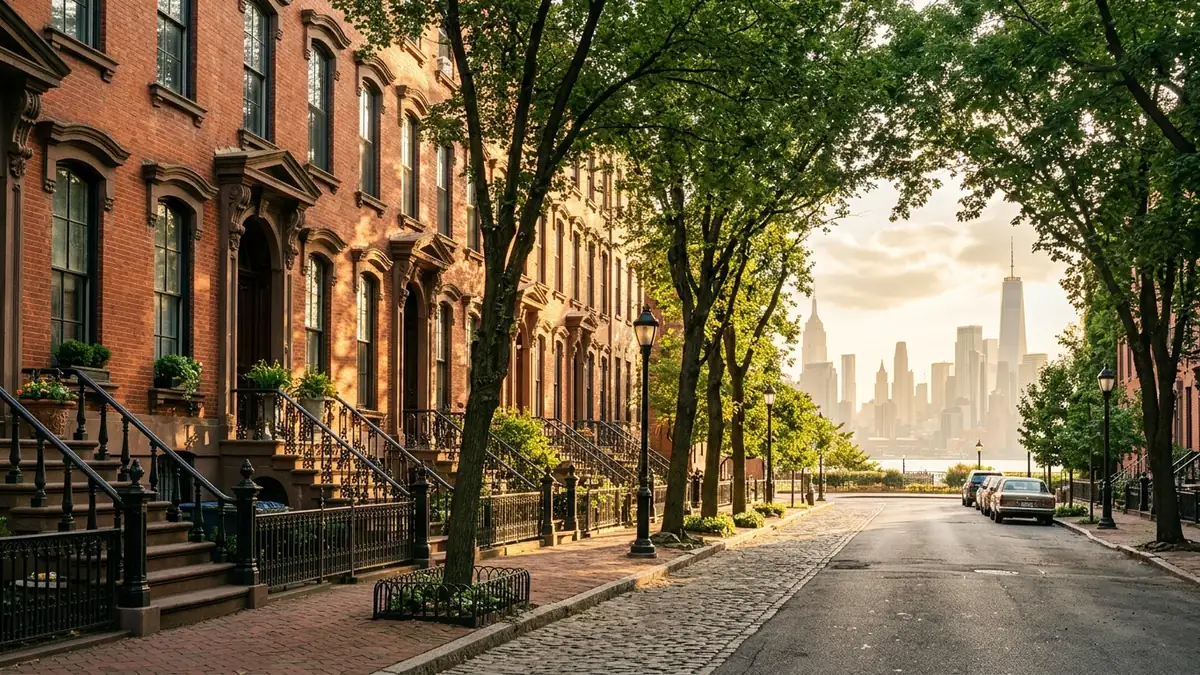
Walk down Bloomfield Street, Garden Street, or Park Avenue between 5th and 9th Streets and you will find tree-lined stoops, historic ironwork, quiet residential traffic, and neighborhood staples tucked onto corner storefronts. Church Square Park (4th to 5th Streets between Willow and Garden) anchors the district with multiple shaded playgrounds, a fenced dog run, and a cushioned walking loop, making it a daily social hub for parents, dog owners, and remote workers grabbing a break between calls. You are also surrounded by independent cafés highlighted in our coffee shops for remote work in Hoboken roundup and dozens of sidewalk patios featured in our Hoboken outdoor dining guide.
For groceries, Midtown residents lean on ACME Markets at 614 Clinton Street, specialty Italian delis along Washington and Willow, and quick walks south to Downtown or west to ShopRite. Commuting from Midtown is uniquely flexible: most residents can walk 12 to 18 minutes to the PATH train on crisp mornings or catch the 126 bus right on Washington Street or Willow Avenue in under two minutes.
4. Uptown Hoboken (11th to 16th Street & Hudson Tea)
Uptown Hoboken—spanning 11th Street through 16th Street east of Clinton—has evolved into one of the most sought-after family and young-professional residential pockets in the New York metro area. Sidewalks feel wider, evening noise drops sharply compared to Downtown, and architectural scale shifts toward grand loft conversions and refined brick residences.
The landmark Hudson Tea Building (the twin former Lipton Tea factory loft buildings at 1500 Washington Street and 1500 Hudson Street) anchors the northern tip with soaring ceilings, oversized factory windows, and shuttle connections to the PATH. Uptown also punches far above its weight in grocery convenience: Trader Joe's sits at 1350 Willow Avenue, Brooklyn-rooted Urban Market debuted at 1425 Washington Street in March 2025, Kings Food Markets is minutes east on Shipyard Lane, and the full-scale Whole Foods Market in Weehawken sits just across the northern city line on Harbor Boulevard.
Commuters who work in Midtown Manhattan love Uptown because the 126 bus enters the Lincoln Tunnel right from the 14th Street viaduct—cutting out 10 to 15 minutes of local stops—while the NY Waterway 14th Street Ferry glides across to West 39th Street in roughly 8 minutes. The main drawback is PATH distance: walking from 14th Street to Hoboken Terminal takes 22 to 28 minutes, though Citi Bike docks and building shuttles bridge the gap quickly.
5. Castle Point & Stevens Institute Hill
Perched on a dramatic rocky bluff rising above the Hudson River between 5th and 10th Streets east of Washington Street, Castle Point is Hoboken's highest natural ground. The hill is anchored by Stevens Institute of Technology and bordered on the north by Elysian Park, Hoboken's oldest public park, shaded by towering mature trees.
Surrounding the campus—especially along Castle Point Terrace, Hudson Street, and 8th to 10th Streets—sit some of Hoboken's grandest historic single-family townhouses and stately brownstone condos. Because Castle Point rests on Palisades bedrock well above tidal surge lines, residents enjoy rare peace of mind during coastal storms and torrential summer cloudbursts. Views from the Stevens campus overlook span from the Empire State Building down to One World Trade Center.
Inventory here is scarce and rarely cheap. Students bring daytime vitality near campus pathways during the academic year, yet the residential blocks immediately north and south of Stevens remain among the quietest and most scenic streets anywhere in the city.
6. West Hoboken & Northwest (7th to 16th Street, West of Clinton)
Twenty years ago, western Hoboken past Madison Street was dominated by warehouses, light-industrial factories, and parking lots. Today, West and Northwest Hoboken represent the city's fastest-modernizing residential zone—and arguably the best value per square foot for renters and condo buyers who want modern floor plans, central HVAC, in-unit laundry, and on-site parking.
Two community anchors transformed this corridor. First, ResilienCity Park (over 5 acres between 12th and 13th Streets along Madison and Adams) opened as Hoboken's largest public park, blending athletic fields, playgrounds, open lawns, and seasonal plaza programming atop a 2-million-gallon underground stormwater detention and pump system. Second, ShopRite at 900 Madison Street gives western residents immediate access to Hoboken's largest suburban-format supermarket with surface parking, while The Monroe Center at 720 Monroe Street (a converted Levolor blinds factory) provides arts studios, dance schools, fitness gyms, and family programming.
Transit revolves around the Hudson-Bergen Light Rail 9th Street–Congress Street station (connecting smoothly south to Hoboken Terminal or Jersey City's Exchange Place and Newport) plus the 126 Willow Avenue bus a few blocks east. Watch-out: Northwest Hoboken sits in the historic low-lying western basin, so while the H5 wet-weather pump station and ResilienCity Park dramatically cut routine flash flooding, buyers and renters should still inspect FEMA flood maps and avoid basement-level units.
7. Southwest Hoboken (Observer Highway to 5th Street, West of Willow)
Tucked into the southwestern corner between Observer Highway and 5th Street along Madison, Monroe, Jackson, and Harrison Streets, Southwest Hoboken appeals to drivers, value-minded buyers, and commuters splitting trips between Jersey City, New Jersey highways, and Manhattan.
Newer residential mid-rises and loft-style condos line Jackson and Harrison Streets, paired with quick access to the 2nd Street Light Rail station and a 12- to 16-minute walk to the PATH train. A major quality-of-life milestone here is the expanded Southwest Resiliency Park at Jackson Street and Observer Highway, which grew from its original 1-acre footprint into a roughly 2-acre community hub featuring rain gardens, playgrounds, sports courts, a dog run, and subterranean cisterns holding roughly half a million gallons of stormwater runoff. Just north, the 7th & Jackson Resiliency Park adds an indoor gymnasium, plaza, and over 470,000 gallons of additional rainwater detention.
Because Southwest Hoboken sits at the base of the Palisades cliff—creating a natural bowl effect during heavy cloudbursts—the H1 wet-weather pump station near Observer Highway plays an essential role in clearing streets against high tides. Commuters who drive out to suburban New Jersey offices via Route 139, I-78, or the NJ Turnpike appreciate bypassing Washington Street gridlock altogether.
Uptown Hoboken vs. Downtown Hoboken: Which Side Fits Your Routine?
Nearly every prospective resident eventually narrows their search down to Uptown Hoboken vs. Downtown. Both halves share the same 07030 zip code, municipal services, and walkability, yet daily routines feel noticeably different north and south of 8th Street.
| Decision Factor | Downtown (Observer Hwy – 4th St) | Uptown (11th – 16th St) |
|---|---|---|
| Primary NYC Transit | PATH train (WTC & 33rd St) + NJ Transit rail + South Ferry | NJ Transit 126 express-style bus + 14th St NY Waterway Ferry |
| Best Manhattan Work Zone | Financial District, SoHo, West Village, Flatiron, Midtown South | Midtown West, Hudson Yards, Times Square, Bryant Park, Midtown East |
| Evening Energy & Noise | High energy on Newark, 1st & lower Washington; lively nightlife | Calm, neighborhood dining, family-friendly streets after 9:00 PM |
| Housing Stock | Walk-up brick apartments, classic brownstones, select mid-rises | Large loft conversions (Hudson Tea), Waterfront towers, brownstones |
| Grocery Anchors | Whole Foods Market Daily Shop (101 Washington), Organic Basic Food | Trader Joe's (1350 Willow), Urban Market (1425 Washington), Kings (Shipyard) |
Choose Downtown if your job is near World Trade Center or the 6th Avenue PATH stops, you enjoy walking home from late dinners or pubs without calling a rideshare, and you want quick rail access to Newark Airport or NJ Transit weekend trains. Choose Uptown if you commute to Midtown Manhattan, prioritize stroller-friendly sidewalks and quieter sleep, want immediate Trader Joe's and waterfront park access, or prefer newer elevator buildings with larger floor plans.
2026 Hoboken Rent & Real Estate Price Ranges by Zone
Market disclaimer: Rental rates and home sale prices in Hoboken shift seasonally—peaking from May through September—and vary widely by building age, elevator access, laundry setup, outdoor space, and flood-zone insurance requirements. Use the 2026 market ranges below as planning benchmarks and verify live MLS or leasing listings before budgeting.
Across major rental market trackers including Zumper, RentCafe, Apartments.com, and Zillow, Hoboken remains one of the highest-demand urban housing markets in New Jersey:
- Studios: Typically $2,600 to $3,350/month, with older Downtown/Midtown walk-ups at the lower end and newer Western or Waterfront amenity buildings at the top.
- 1-Bedroom Apartments: Citywide averages cluster between $3,550 and $3,900/month (roughly 700–800 sq. ft.), though classic walk-ups without central air can still list around $2,950–$3,400, while full-service Waterfront towers frequently exceed $4,200–$4,800.
- 2-Bedroom Apartments: Citywide averages generally run $4,300 to $4,960/month (around 1,000–1,100 sq. ft.), pushing $5,400 to $6,800+ in luxury Uptown Waterfront buildings like Maxwell Place or Shipyard.
- Condos & Townhomes (For Sale): Overall Hoboken median home values hover around $916,000 to $990,000 across Zillow and Redfin data, translating to roughly $880 to $960+ per square foot. Entry-level 1-bedroom condos often trade between $550,000 and $750,000, renovated 2-bedroom condos between $850,000 and $1.3 million, and entire historic brownstones or prime Northeast waterfront duplexes commonly command $1.4 million to well over $2.5 million.
Two hidden budget items catch newcomers off guard when moving to Hoboken. First, garage parking in private residential buildings or municipal garages typically adds $250 to $400+ per month per vehicle. Second, condo buyers should inspect HOA monthly dues closely: full-service waterfront buildings and older structures in FEMA flood zones carry higher master insurance policies than elevated Midtown walk-ups.
Flood Zones, Elevation & Rebuild by Design: What Renters and Buyers Must Check
Most glossy neighborhood overviews skip the single most important physical fact about living in Hoboken: topography and water management. Roughly half of Hoboken was built over historic tidal marshland on the western side of the city, while the eastern spine—peaking at Castle Point—sits on much higher ground. After Superstorm Sandy inundated large stretches of Hoboken in 2012, the city became a national proving ground for urban flood defense.
FEMA Flood Zones (Zone AE vs. Zone X)
Before signing a lease or submitting a real estate offer, look up the exact street address on FEMA's Flood Map Service Center:
- FEMA Zone AE (Special Flood Hazard Area): Represents a 1% annual chance of flooding (100-year floodplain). Much of low-lying Western Hoboken, Southwest Hoboken, and low waterfront perimeter strips fall inside Zone AE. Federally backed mortgages require mandatory flood insurance here, and ground-floor or garden-level units carry higher water-intrusion risk during extreme coastal surges.
- FEMA Zone X: Moderate-to-minimal flood hazard areas—including Castle Point, Stevens Hill, and elevated stretches of Washington, Hudson, Bloomfield, and Garden Streets. Flood insurance is generally optional for lenders here, though heavy summer cloudbursts can still overwhelm local storm drains at low intersections.
Hoboken's Multi-Layered Flood Defenses in 2026
Hoboken's flood protection is far stronger today than a decade ago thanks to three coordinated systems:
- Wet-Weather Pump Stations: Operated with the North Hudson Sewerage Authority, the H1 pump station (Southwest/Observer Highway) and H5 pump station (Northwest/Madison corridor) actively force rainwater into the Hudson River even during high tide.
- Resiliency Parks as Subterranean Sponges: ResilienCity Park (up to 2 million gallons), the expanded Southwest Resiliency Park (roughly 460,000–510,000 gallons), and 7th & Jackson Resiliency Park (over 470,000 gallons) capture millions of gallons of flash-flood runoff underneath everyday playgrounds and lawns.
- Rebuild by Design – Hudson River Project: Backed by federal HUD funding and managed by the New Jersey Department of Environmental Protection alongside the City of Hoboken, the heavy Resist coastal-defense infrastructure—comprising floodwalls, levees, and deployable storm-surge gates—is in active construction across northern and southern Hoboken through 2025 and 2026. Renters and buyers near the southern waterfront (including temporary street work zones such as Grove Street) and along sections of the Hudson River Waterfront Walkway should expect localized detours while permanent flood-gate foundations and drainage ties are completed.
Practical local rule: Never judge flood risk solely by neighborhood label—judge it by block elevation and floor level. A fourth-floor elevator condo in West Hoboken stays completely dry during a cloudburst, while a below-grade garden apartment near a low intersection can face basement seepage. Always ask landlords or sellers whether the building has backflow preventers, elevated mechanicals, and past water-intrusion disclosures.
Commute Times & Transit Reality by Neighborhood
Hoboken is one of the rare American cities where most households commute comfortably without starting a car. For complete fare rules, peak headways, and weekend detours, pair this section with our full Hoboken public transportation breakdown. Here is how typical door-to-door Manhattan commutes play out by zone:
- PATH Train (Hoboken Terminal): Runs directly to World Trade Center (~11–13 minutes on weekdays) and 33rd Street via Christopher, 9th, 14th, and 23rd Streets (~14–18 minutes). Peak trains arrive every 5 to 10 minutes. Note that late-night and weekend service runs on a combined Journal Square–33rd Street via Hoboken pattern, adding a few extra minutes.
- NJ Transit 126 Bus (Washington St & Willow Ave): Runs every 5 to 10 minutes during weekday rush hour straight into the Port Authority Bus Terminal at 42nd Street. From Uptown (12th–15th Streets), the bus ride through the Lincoln Tunnel often takes just 15 to 22 minutes in the exclusive bus lane (XBL); from Downtown, plan on 25 to 35 minutes depending on local stops.
- NY Waterway Ferries: Depart from both Hoboken Terminal (serving Brookfield Place, Pier 11/Wall St, and Midtown W. 39th St) and Hoboken 14th Street (serving Midtown W. 39th St and Lower Manhattan on weekday schedules). Crossing times average 8 to 12 minutes, making ferries the fastest scenic option for Waterfront and Uptown commuters willing to pay higher per-ride fares.
- Hudson-Bergen Light Rail: Serves Hoboken Terminal, 2nd Street, and 9th Street–Congress Street along the western edge, linking western residents south to Jersey City's financial district (Exchange Place/Newport) or north toward Weehawken and North Bergen.
What about keeping a car? If you commute within New Jersey or take frequent weekend trips upstate, owning a car in Hoboken is doable—especially in West or Southwest buildings with attached garages—but street parking requires mastering resident permit zones, street-sweeping schedules, and municipal garages like Garages B, D, and Midtown. Read our Hoboken parking guide before deciding whether to bring a vehicle.
Groceries, Parks & Schools: Everyday Family Infrastructure
Long-term livability in Hoboken depends on how easily you can handle groceries, outdoor play, and school drop-offs on foot.
Full 2026 Grocery Anchor Map
Instead of one mega-suburban strip mall, Hoboken spreads grocery coverage across every quadrant—and if you are scouting options beyond city limits, check our broader grocery stores near me directory too:
- Uptown / North: Trader Joe's (1350 Willow Ave), Urban Market (1425 Washington St, opened March 2025), Kings Food Markets (1212 Shipyard Ln), plus Whole Foods Market Weehawken just north of 15th Street.
- Midtown & West: ShopRite (900 Madison St—full-scale supermarket with parking lot) and ACME Markets (614 Clinton St).
- Downtown: Whole Foods Market Daily Shop (101 Washington St, opened December 2025) and Organic Basic Food (204 Washington St).
Parks & Waterfront Recreation
Every neighborhood sits within a 5-to-8-minute walk of substantial green space: Pier A and Pier C serve Downtown; Church Square Park anchors Midtown; Elysian Park and Maxwell Place Park serve Castle Point and Uptown; and ResilienCity Park, 7th & Jackson, and Southwest Resiliency Park give western Hoboken more open lawn and playground acreage than ever before.
Hoboken Public Schools & Universal Free Pre-K
One of the biggest financial reasons young families stay in Hoboken instead of moving immediately to suburban Bergen or Essex County is free full-day public Pre-K 3 and Pre-K 4. As a state-funded early childhood district, the Hoboken Public School District guarantees free full-day preschool for eligible 3- and 4-year-old Hoboken residents (children turning 3 or 4 by September 30), operated across district elementary schools—including Joseph F. Brandt Elementary (215 9th St), Thomas G. Connors Elementary (208 Monroe St), Wallace Elementary (1100 Willow Ave), and the Early Learning Center at Calabro (524 Park Ave)—plus contracted partner sites such as HOPES CAP locations.
For kindergarten through 8th grade, families have zoned district schools alongside popular public charter options allocated by lottery, notably HoLa (Hoboken Dual Language Charter School) (123 Jefferson St for K–4; 301 Garden St for 5–8) and Elysian Charter School of Hoboken (1460 Garden St, K–8). Always verify exact elementary school catchment zones directly with the Hoboken Board of Education before buying a home based on a specific building.
Living in Hoboken: Honest Pros, Cons & Moving Checklist
The Real Pros of Living in Hoboken
- True 15-minute walkability: Groceries, pediatricians, cafés, waterfront running paths, and transit stops are almost always within ten blocks.
- Unmatched Manhattan proximity without NYC city income tax: New Jersey residents avoid New York City's local municipal income tax (roughly 3.0%–3.9%), which often offsets a sizable slice of Hoboken rent or condo HOA dues.
- Strong neighborhood continuity: Free public Pre-K, youth sports leagues, farmers markets, and active local businesses create a tight-knit community feel rarely found so close to Midtown.
The Real Cons to Factor In
- High housing and parking costs: Competition for renovated two-bedroom rentals and condos remains fierce, with properties routinely leasing or closing within weeks.
- Street parking friction: Alternate-side street cleaning, visitor pass rules, and storm-emergency garage moves make car ownership tedious if you lack a dedicated garage spot.
- Localized flood vigilance & weekend crowds: Western blocks require flood-map awareness during tropical storms or nor'easters, while Downtown's Washington and Newark Streets get loud on weekend nights and event days like Santacon or St. Patrick's weekend.
5-Point Apartment & Home Touring Checklist
- Test your actual rush-hour commute: Walk from the front door to the PATH, 126 bus stop, or ferry pier at 8:15 AM on a weekday—not on a sunny Sunday afternoon.
- Verify FEMA flood zone and mechanical elevation: Check whether the building sits in Zone AE or Zone X, ask where the boiler/HVAC sits, and check basement or garage drainage history.
- Inspect laundry, soundproofing, and elevator access: Historic walk-ups offer unmatched charm and lower HOA/rent, but carrying strollers or Trader Joe's bags up four narrow flights gets old fast.
- Visit the block on Friday at 10:00 PM: Confirm whether nearby bars, garbage collection trucks, or bus routes affect bedroom noise.
- Price out total monthly carry: Add municipal or private garage parking ($250–$400+/month), utilities, renter's/flood insurance, and PATH/bus/ferry passes before comparing Hoboken against Jersey City or Manhattan.
Key takeaways
- Hoboken's 1.25 square miles split into 7 distinct zones where walking four avenues east or west shifts elevation, rent, building age, and transit options dramatically.
- Match your neighborhood to your Manhattan destination: Downtown wins for PATH rides to WTC and 6th Ave, while Uptown and the Waterfront win for 126 bus and 14th St ferry rides to Midtown.
- Always verify FEMA Flood Zone AE vs. Zone X and avoid below-grade units in low-lying western blocks—even though ResilienCity Park, Southwest Resiliency Park, H1/H5 pumps, and Rebuild by Design have vastly improved drainage.
- 2026 grocery access covers every corner of town, highlighted by Whole Foods Market Daily Shop (101 Washington St), Urban Market (1425 Washington St), Trader Joe's (1350 Willow Ave), ShopRite (900 Madison St), ACME (614 Clinton St), and Kings (1212 Shipyard Ln).
- Families gain major long-term value from Hoboken Public Schools' universal free full-day Pre-K 3 and Pre-K 4 program alongside neighborhood parks and charter options like HoLa and Elysian Charter School.
Frequently asked questions
Is Uptown or Downtown Hoboken better to live in?
Downtown (Observer Highway to 4th Street) is better if you commute via the PATH train to Lower Manhattan or Greenwich Village and want lively bars, restaurants, and late-night convenience outside your door. Uptown (11th to 16th Street) is better if you commute to Midtown Manhattan via the 126 bus or 14th Street ferry and want quieter residential blocks, wider sidewalks, and immediate access to Trader Joe's and waterfront parks.
Which Hoboken neighborhoods are best for families vs. young professionals?
Families typically gravitate toward Uptown, Maxwell Place, Midtown brownstone blocks around Church Square Park, and Northwest Hoboken near ResilienCity Park for larger two- and three-bedroom layouts, calmer streets, and proximity to playgrounds and Pre-K sites. Young professionals often start in Downtown or lower Midtown for the shortest walk to the PATH train and nightlife along Newark, 1st, and lower Washington Streets.
Does Hoboken still flood, and which neighborhoods sit on the highest ground?
Castle Point around Stevens Institute of Technology and elevated eastern blocks along Hudson, Washington, Bloomfield, and Garden Streets sit on high bedrock (largely FEMA Zone X) and rarely see street flooding. Low-lying western and southwestern blocks fall largely in FEMA Zone AE; while wet-weather pump stations (H1 and H5), resiliency parks like ResilienCity Park (2 million gallons), and ongoing Rebuild by Design floodwalls have significantly reduced flooding, renters and buyers should still inspect building elevation and skip basement-level units.
Can you live car-free in Hoboken, and which neighborhood is easiest if you own a car?
Yes—Hoboken is one of the easiest cities in the United States for car-free living thanks to the PATH train, NJ Transit 126 bus, Hudson-Bergen Light Rail, NY Waterway ferries, and walkable grocery stores in every quadrant. If you do keep a car for New Jersey commuting or weekend trips, Northwest and Southwest Hoboken are easiest because modern buildings routinely include attached garages and offer quick exits toward Route 139, I-78, and the Lincoln Tunnel without crossing Washington Street.
What are realistic 2026 rent and condo prices in Hoboken?
Across 2026 rental market benchmarks, average 1-bedroom apartments in Hoboken typically run $3,550 to $3,900 per month and 2-bedrooms average $4,300 to $4,960 per month, with older walk-ups pricing lower and full-service Waterfront towers running substantially higher. On the purchase side, median condo and townhome prices hover around $920,000 to $990,000 ($880 to $960+ per square foot), while full historic brownstones regularly sell for $1.4 million to over $2.5 million.
How do grocery shopping and public schools work across Hoboken neighborhoods?
Every quadrant has a major grocery anchor: Trader Joe's (1350 Willow Ave), Urban Market (1425 Washington St), and Kings (1212 Shipyard Ln) serve Uptown; ShopRite (900 Madison St) and ACME (614 Clinton St) serve West and Midtown; and Whole Foods Market Daily Shop (101 Washington St) plus Organic Basic Food (204 Washington St) serve Downtown. For families, the Hoboken Public School District provides free full-day Pre-K 3 and Pre-K 4 across district schools (Brandt, Connors, Wallace, Calabro) and partner sites, alongside zoned K–8 schools and lottery-based charter schools like HoLa and Elysian.
Rental prices, home values, construction detours, and retail hours in Hoboken change seasonally. Confirm exact flood-zone designations, school catchment boundaries, transit timetables, and lease terms directly with official agencies and property managers before signing.
Sources
- City of Hoboken Official Portal (Parks, Parking & Municipal Services)
- NJDEP Rebuild by Design – Hudson River Flood Resilience Project
- Port Authority PATH Train Schedules & Maps
- NJ Transit Bus (126) & Hudson-Bergen Light Rail Schedules
- Hoboken Public School District (Universal Free Pre-K & K–12)
Related guides
 Things to Do on the Hoboken Waterfront: Parks, Activities & Skyline ViewsPlan the best Hoboken waterfront activities: skyline parks from Pier A to Maxwell Place, free summer kayaking, sail…